
Builds & upgrades
Azeroth Survivors Mage Build: Frost Choices and Tradeoffs
For an established Mage, Blizzard and Frostbolt form a recorded Frost option: invest in useful upgrades for those two spells, then adapt to the necklace you receive. It offers strong crowd control and area clearing, but the source player also reports weak single-target damage and severe frame-rate problems. Choose it for that balance of benefits and costs, rather than expecting effortless boss kills.
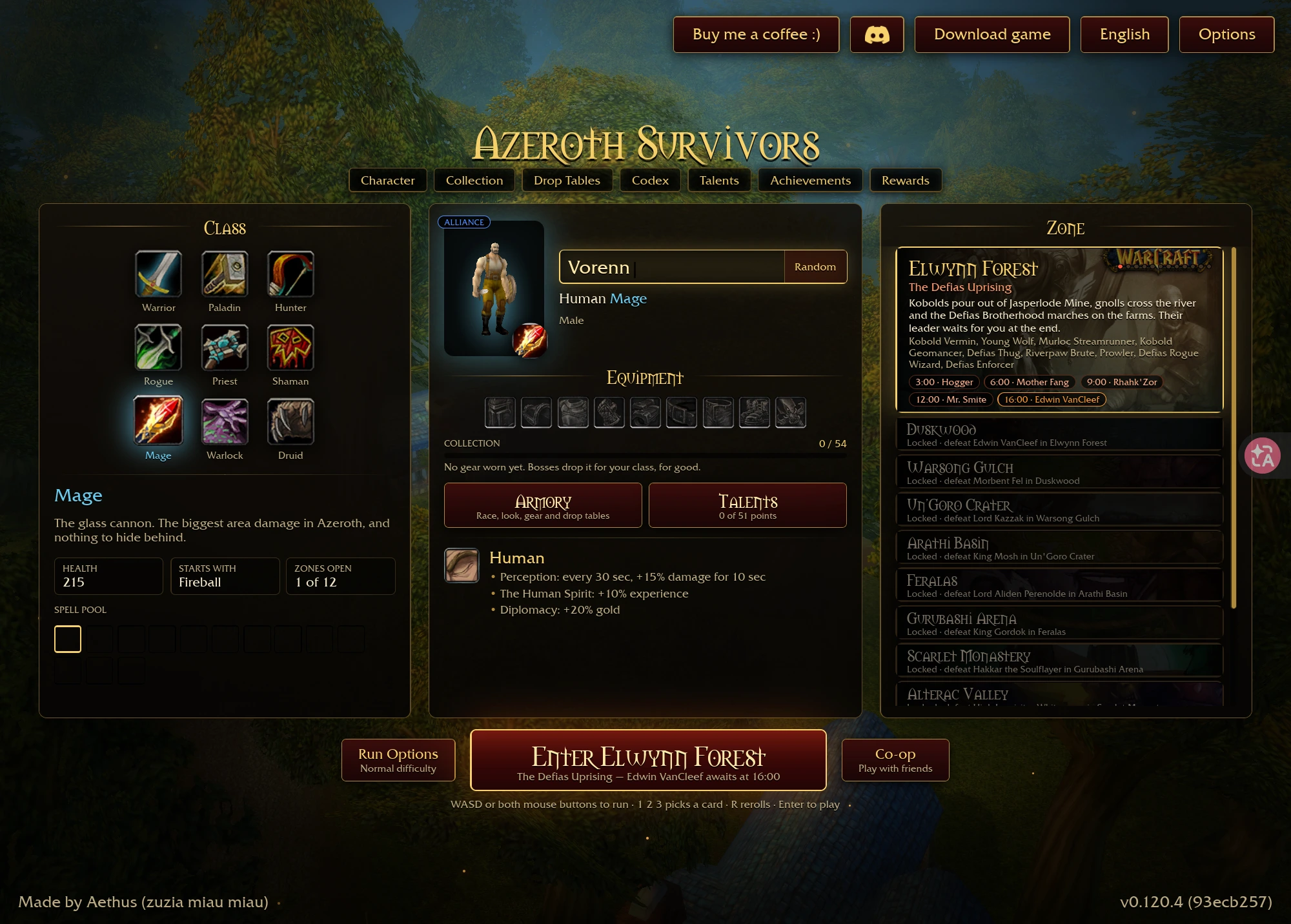
A fresh Mage is a different starting point. The original game's v0.120.4 menu capture from October 27, 2026 shows a Human Mage with 215 health, Fireball, no equipped permanent gear and zero talent points. The late-game Frost example below does not start under those conditions.
Decide whether this Frost route fits your run
| Your situation | Useful direction | What to watch |
|---|---|---|
| You have an established Mage and want room control | Explore the Frost setup below | The legendary necklace is random; performance can deteriorate. |
| Enemies die in groups but bosses linger | Preserve investment in Frostbolt alongside Blizzard | Large total damage does not establish good boss damage. |
| Your game already struggles with many effects | Treat additional Blizzard stacking cautiously | The creator reports slowdown even on a good computer. |
| You have just selected a new Mage | Start with your actual Fireball and available choices | A completed talent split is a later reference, not an opening allocation. |
Holdherhand explains the Frost setup from 0:08 in the original guide. The recording's exact game build is unknown; these are the creator's choices and experience, not a current-best benchmark.
Clicking play connects to YouTube. Watch on YouTube ↗
The recorded talents and spell plan
Holdherhand describes 37 points in Frost and 14 in Arcane, including an Arcane luck node. That accounts for 51 points, but it does not provide a reliable node-by-node spending order. Open your own talent trees and compare their effects before copying a total.
In the spell explanation at 0:56, he includes Frostbolt, Blizzard and several supporting spells, then banishes Ice Armor, Blast Wave and Frost Nova from later offers. The main damage investment stays with Blizzard or Frostbolt, choosing between the higher-quality useful upgrades available.
Use that as a way to narrow later choices. It is not a guarantee that your early offers will arrive in the same order. Keep enough damage and movement space to establish the run before attempting the source player's low-movement style.
Choose jewelry around what actually drops
The creator's accessory priorities begin at 0:21:
| Slot | Recorded preference | Alternative described |
|---|---|---|
| Necklace | Blizzard-related legendary | Frostbolt-related necklace, then a luck or useful general option. |
| Rings | Damage and cooldown reduction | Compare the effects offered in your run. |
| Trinkets | Luck and double cast | Damage instead of luck. |
Read the offered necklace's current effect before redirecting upgrades. The video describes the Blizzard necklace as adding powerful effects, including an explosion tied to enemy maximum health. That historical explanation does not establish the current item's exact numbers.
Luck is the creator's preference, not insurance against a missing legendary. In this recording, a major late necklace pickup comes at 22:54. Plan to keep playing with useful alternatives instead of assuming the first cache completes the build. The items guide separates run jewelry from permanent class equipment.
Read the next upgrade against the current problem
If packs remain dangerous, consider the Blizzard option that improves the part of its effect you still need. If crowd control is already comfortable but a boss remains alive, examine the Frostbolt offer instead of judging everything by screen-wide damage.
A rarer card can still improve the wrong property. Once an area effect already covers the enemies relevant to your position, more coverage may do less for the current problem than damage or another useful upgrade. Compare the actual card text; there is no universal radius target established here.
Use the damage meter to distinguish boss pressure from overall clearing. The source run later has different numbers of ranks in Blizzard and Frostbolt, so their damage rows are not an equal-investment experiment.
Account for the two major weaknesses
Boss damage: Holdherhand explicitly calls the single-target damage poor at 16:05. The easy area clear does not remove that limitation. Keep monitoring boss progress and maintain room to move while the fight continues.
Performance: the warning from 15:31 describes overlapping Blizzards destroying frame rate. Later, at 24:42, he says the game timer itself is advancing slowly and stops adding Blizzard ranks. This is a run-time slowdown, separate from a game that fails to load.
A menu setting is not a proven cure for that situation. Holdherhand's separate Paladin recording describes turning off spell effects in Options → Graphics at 22:50. You can check whether your version offers that option, while remembering that hiding effects also removes visual information about your own spells.
Other Mage directions
Arcane is another route to investigate after checking your current tree. A separate account of Holdherhand's Arcane setup describes balancing Arcane Missiles for bosses with Arcane Explosion for packs and using Ice Barrier. It is a secondary description of an unknown-version recording, not an independent comparison against Frost.
For broader choices, return to the build selector or compare the class starting conditions. Keep the goal, permanent investment and performance limits attached to any recommendation you carry into your next run.